Works completed

Marble tiling to common property walls and floor.

Revised plumbing to bathroom.

Cracking to internal garage walls was repaired by strata in 2011, and underpinned in 2015.
Marble tiling to common property walls and floor.
Lot 3 renovations, 2002
Lot 3 was extensively renovated in 2002. It included major bathroom works including the removal of load bearing walls and the laundry. In the kitchen there was revised plumbing, a laminated floor and new kitchen cabinetry. Security gates were installed on all doors and some windows. The work was undertaken by m2design and Lot 3 also commissioned the Chapman Hutchison Report.
In 2010, further upgrades were made and all security gates were removed from doorways. A retrospective engineer's certificate was submitted to Council and in 2018 a retrospective Special By-Law was passed to make some of the renovations from 2002 lawful. The location of the laundry in the kitchen without waterproofing and floor drainage is still unlawful for any Class 2 building.
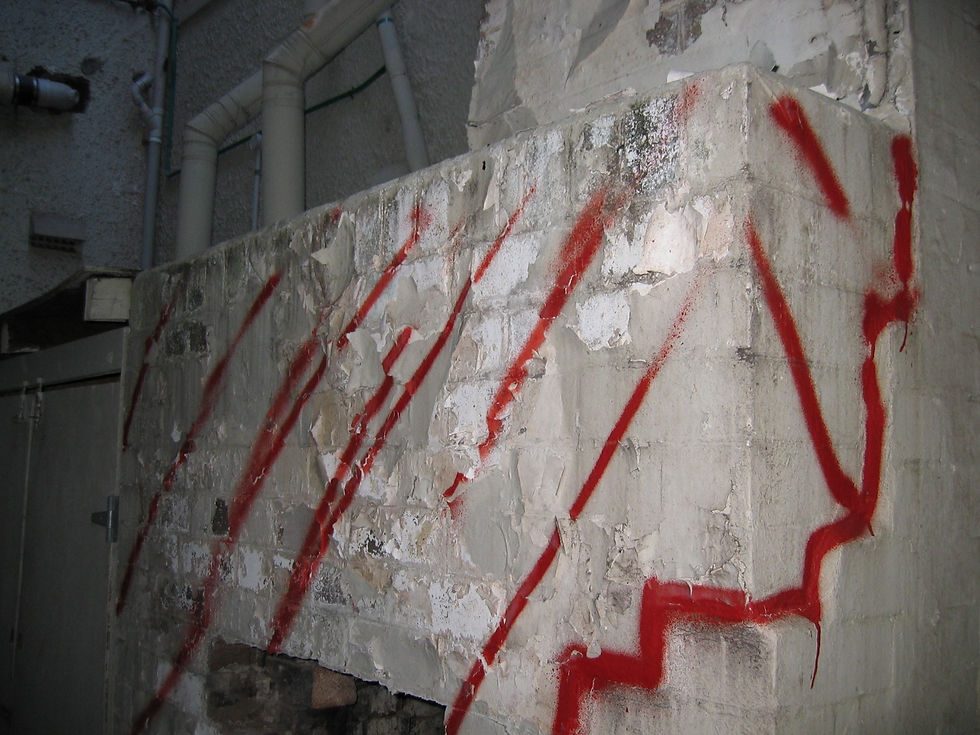
The engineers specified a new steel beam and brick structure.

Chimney base removed and temporary props installed.
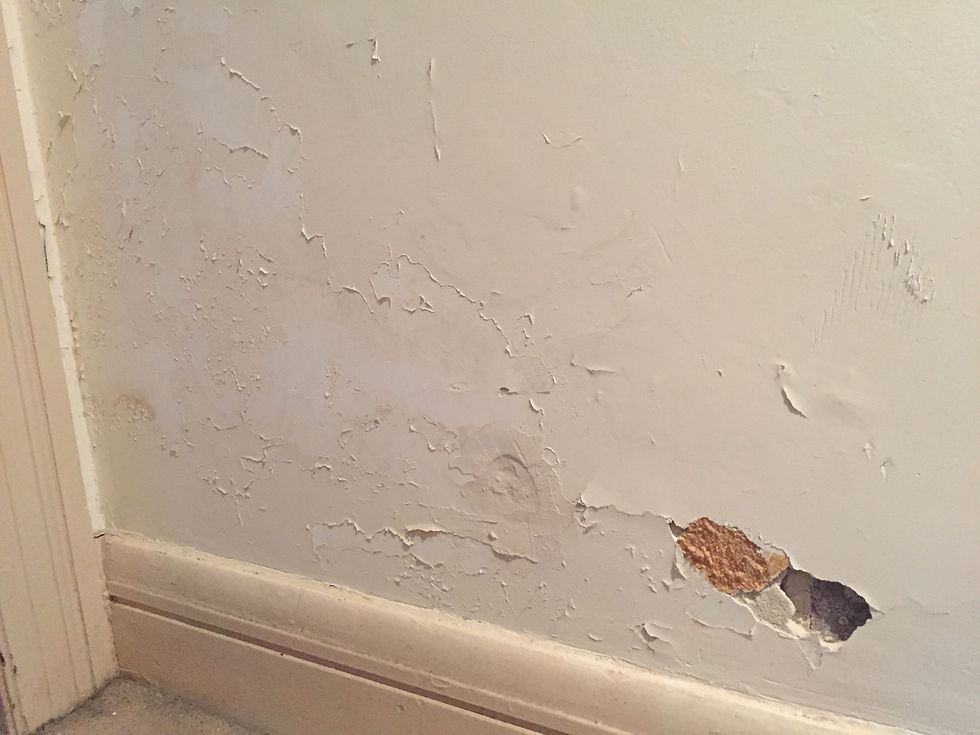
Internal walls in Unit 1 were repaired in 2023.
The engineers specified a new steel beam and brick structure.
Incinerator & chimney stack repairs, 2004
Northrop's engineers specified the detailed works to repair the structural damage to the incinerator chimney in the rear lightwell area. This work had been identified by Chapman Hutchison. The chimney base was opened up to reveal a mass of lime and ash slurry that acted as a sponge for rainwater and caused rising damp and soft brickwork in the adjacent walls. The new enclosure was designed with a louvre door to act as a new boiler house, and this was used until 2013.
The work was designed by Northrop and undertaken by BSR Construction.
The rising damp and soft brickwork to the adjacent internal walls in Lot 1 was repaired in 2022.

Western and southern strata boundaries.

Common property garden area.
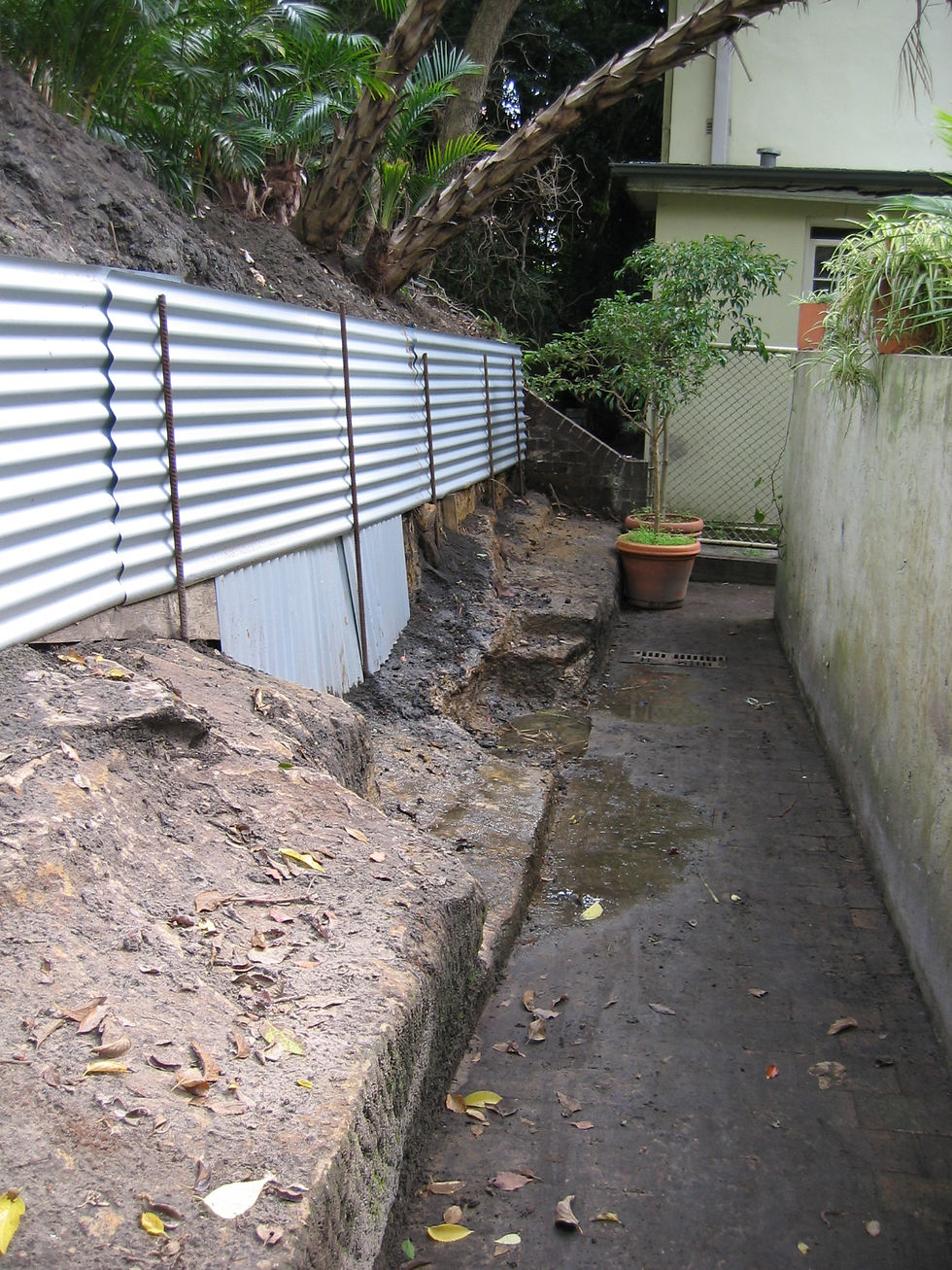
Temporary retaining wall extended into the common property area.
Western and southern strata boundaries.
Western boundary repairs, 2004
The steeply sloped land was cleared along the western boundary and damaged trees and failed retaining walls were removed prior to new terracing and planting.
About 40 new golden cane palms were planted and a new fence was installed along the entire strata boundary at a later date. The large camphor laurel tree in the common property garden was not removed until 2017.
This work was undertaken by BSR Construction with funding from Lot 1 and strata. The terracing to the common property garden is still to be completed.
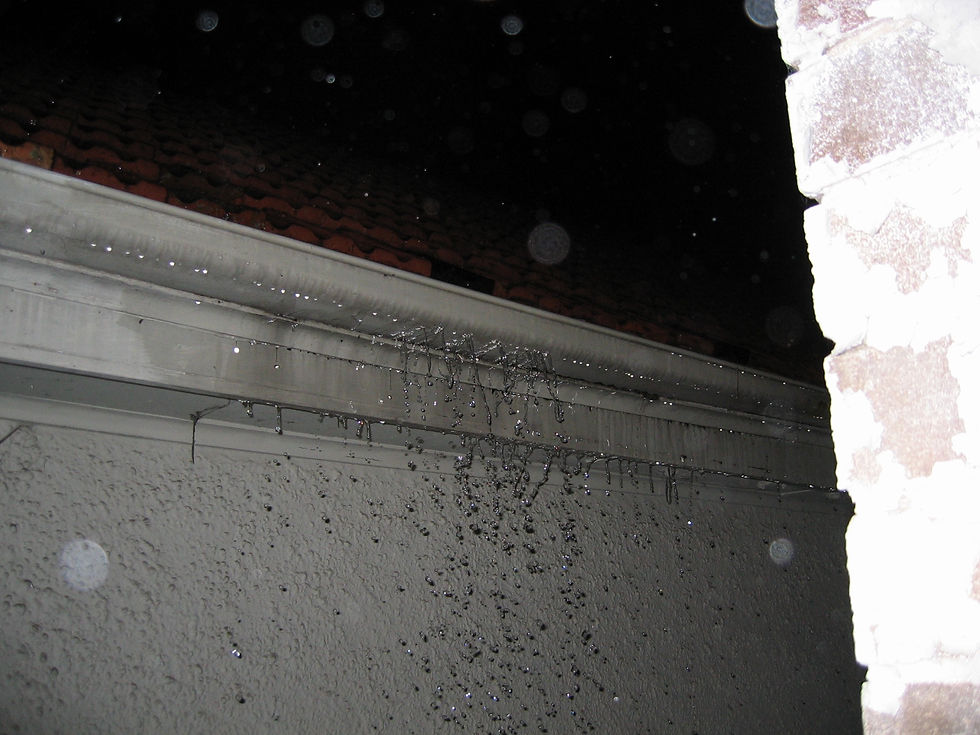
Caused by shallow gutters and a lack of downpipes.
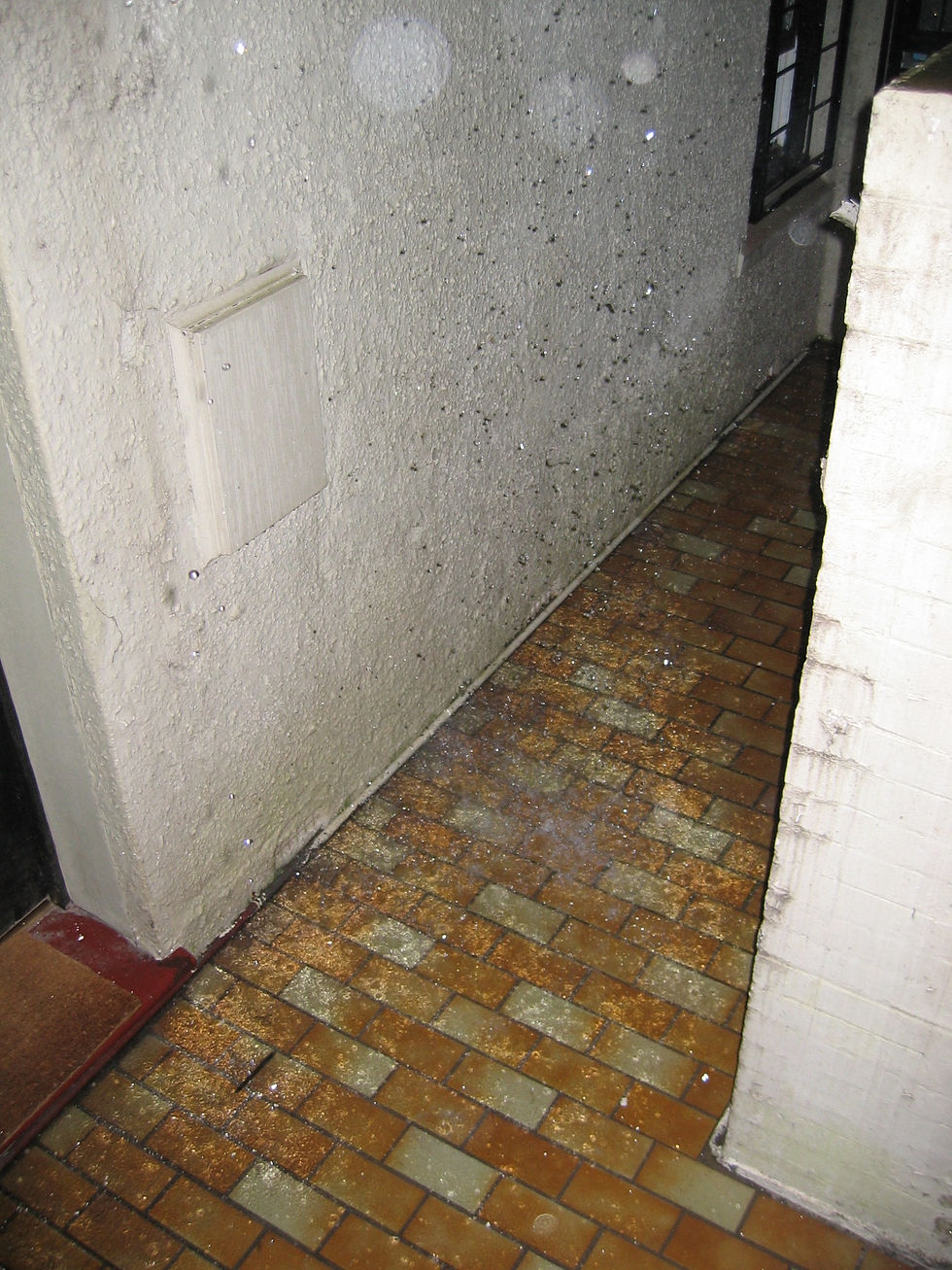
Contributes to rising damp in the light well area as the tile level is above the damp course membrane.
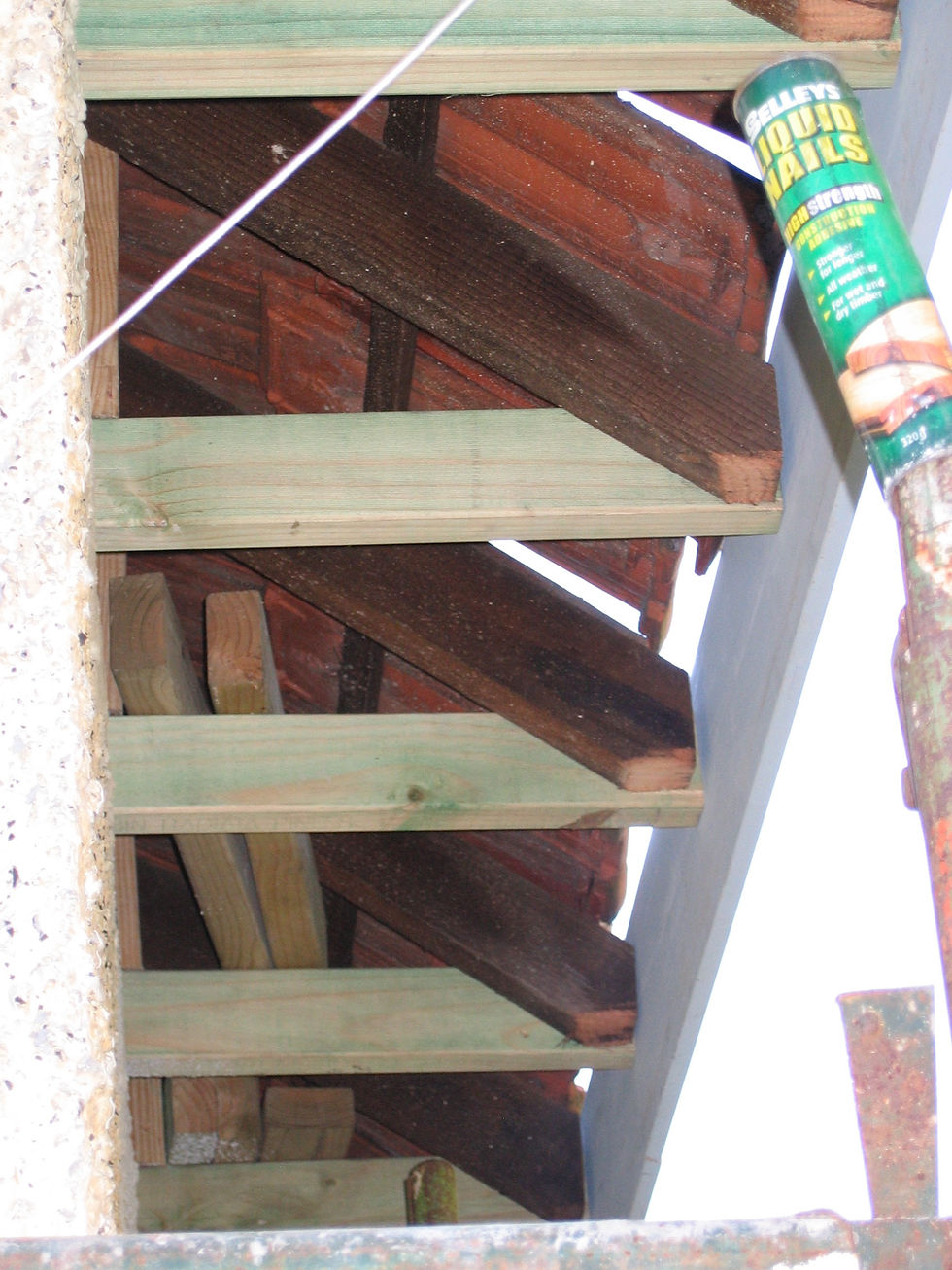
The eaves were rebuilt, and new gutters and downpipes installed.
Caused by shallow gutters and a lack of downpipes.
Lightwell facade repairs, 2005
The original gutters from 1994, or eariler, were too shallow for the amount of rain being collected from such a large roof. This meant that overflowing water was rotting the fascia boards. Where the rot was most prevalent was in the lightwell area where the roof valleys directed a higher proportion of the rainfall.
To address the recommendations in the Chapman Hutchison Report, the lightwell area was filled with scaffold and the gutters were removed. New fascia boards, soffits and deeper gutters were installed. An additional downpipe was also installed to help get the water away. The painted membrane was also renewed but the old calcimine base paint was not removed as part of the process (it was later removed in 2024 when the membrane was again renewed).
The work was undertaken by BSR Construction.

Original clay pipes exposed.

Gas and water pipes were replaced with copper.
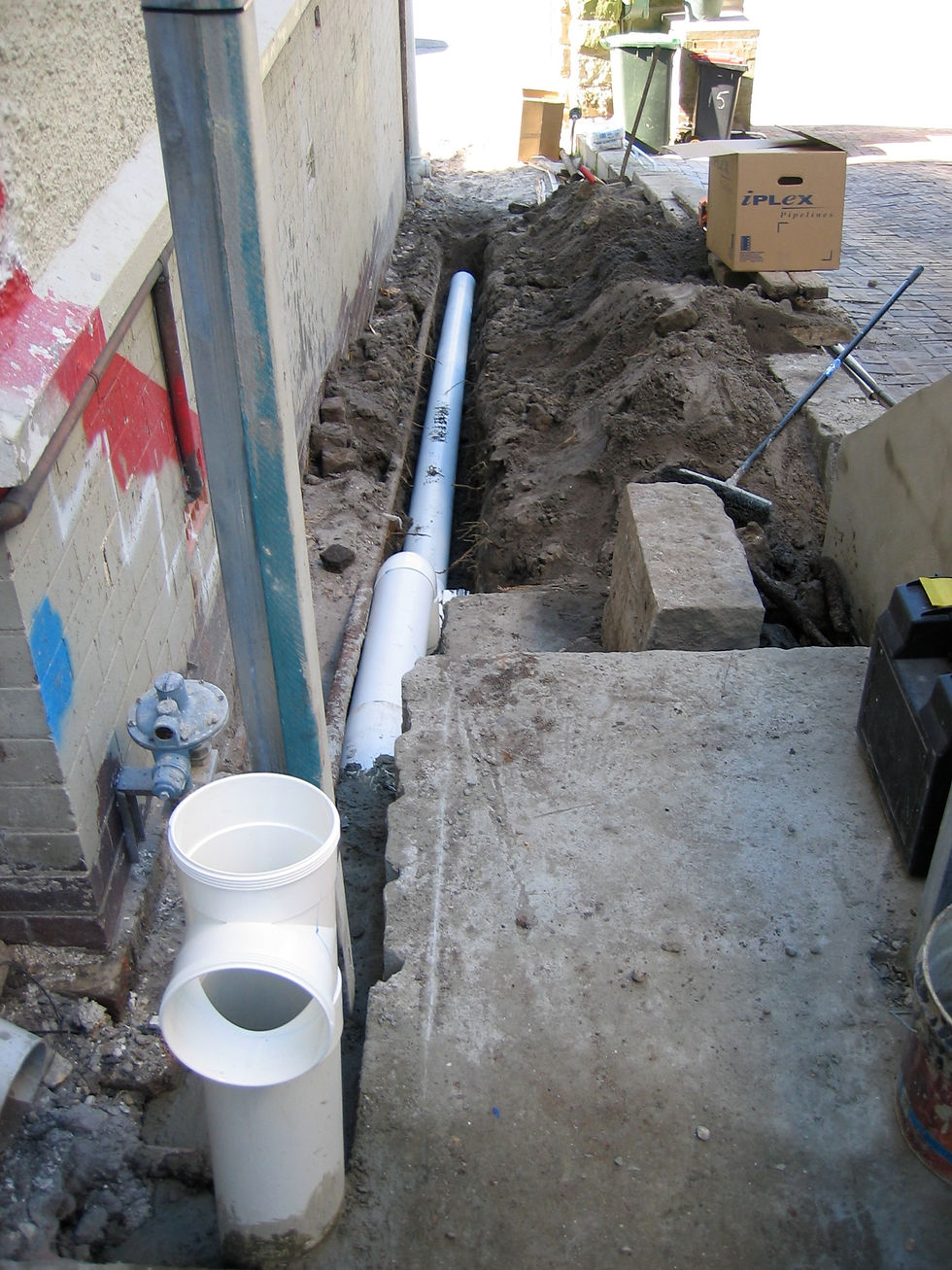
New 150mm drainage under common property area.
Original clay pipes exposed.
Southern storm water upgrade, 2006
A civil/hydraulic engineer was engaged to upgrade the storm water system ahead of a bedroom extension and new roof to Lot 1. This was part of Condition 13 in DA322/2004/1. The storm water and groundwater was directed through a new 150mm pipe and out to the kerb line on Manning Road.
At the same time a new sewer line was connected to an existing branch running under the foundations, and then extended to the boundary trap in 2015 via the driveway sewer system.
All work was undertaken by George Holovsky with funding from Lot 1 (cost $5,400). A Special By-Law covers these works.

Southern retaining wall in 15 Manning Road (the boundary line is the face of this wall).

Large kerb stones on elevated dirt bank (face of the kerb stone is the boundary).

Completed retaining wall with brush fence in 2007 (painted blockwork face is the boundary line).
Southern retaining wall in 15 Manning Road (the boundary line is the face of this wall).
Southern boundary repairs, 2006
The property boundaries are the responsibility of the owners corporation and the southern boundary walls relied on sandstone blocks that were either displaced or temporarily propped. Whilst retaining a sandstone theme, Alba & Associates designed a new boundary wall that provided a wider driveway to 15 Manning Road and gave more space for the planned additions to Lot 1 in 2007.
The work was paid for by Lot 1 in exchange for the exclusive-use of 2.6 metres of common property adjacent the southern gas meters (cost $19,000). The structural work was designed by Alba & Associates and constructed by George Holovsky. A Special By-Law covers these works in addition to a written consent from 15 Manning Road.

Planned removal of the raised garden area to allow for timber decking.

Planned removal of an existing laundry house.
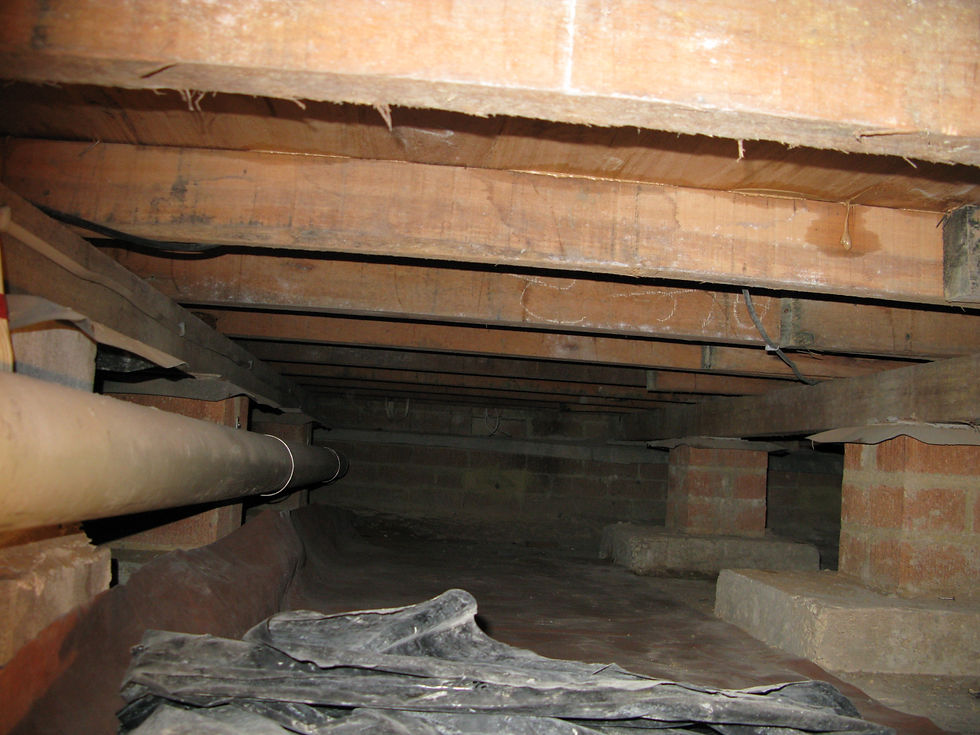
Termite caps and an accessible subfloor area.
Planned removal of the raised garden area to allow for timber decking.
Lot 1 bedroom extension & second bathroom, 2007
The original courtyard to Lot 1 consisted of a small laundry out-house on the back of bedroom 3 and a large paved area.
The laundry was demolished and replaced with a larger room and walk-in wardrobe. A Special By-Law covers these works as well as the southern sewerage and storm water upgrade (2006) and the southern boundary repairs (2006). The gas meters were relocated and all regulators upgraded.
The work was designed by Dunn Architects and Alba & Associates, constructed by George Holovsky, and reviewed by Albert Zenere. All works were funded by Lot 1 (cost $111,695).
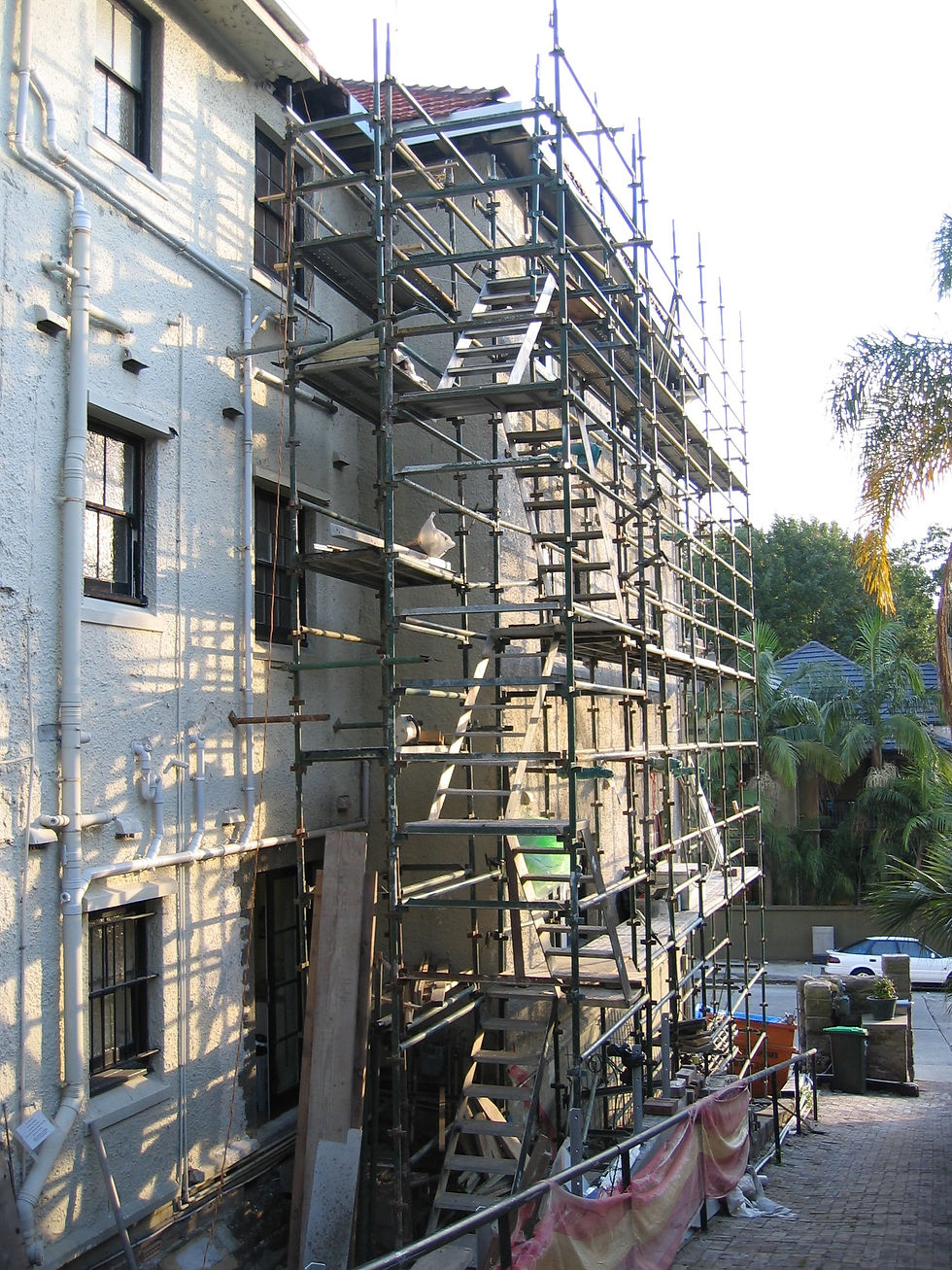
The scaffolding was done in stages and moved as the work progressed.
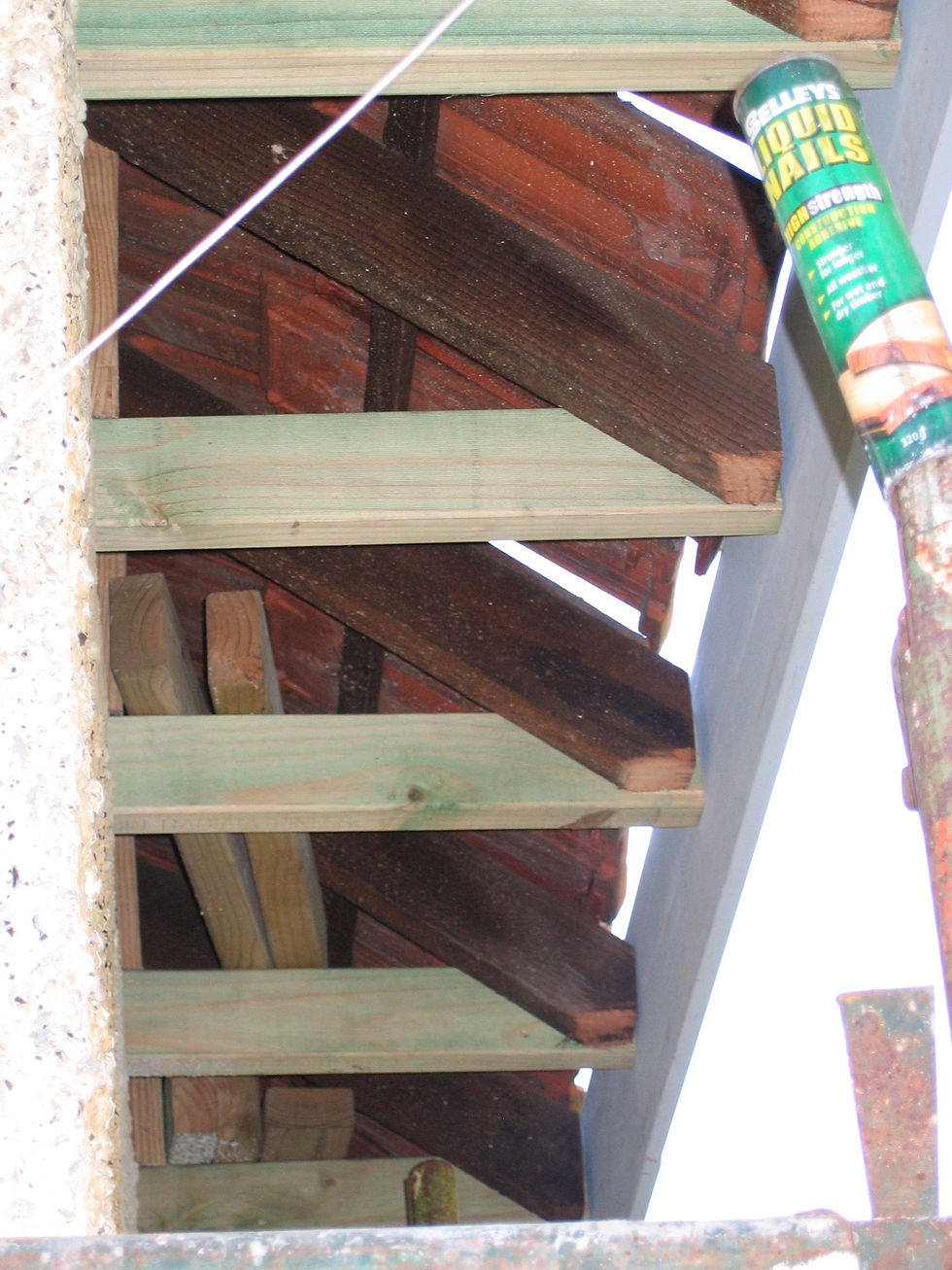
The timber eaves were rebuilt, and gutters and downpipes replaced.

Pressure blasting the old paint layers to get back to the bare render.
The scaffolding was done in stages and moved as the work progressed.
Southern and western facade repairs, 2007
In 2007 the entire southern and western facades were covered in scaffold to address the recommendations in the Chapman Hutchison Report. The eaves and gutters were replaced; all external structural cracking was filled with Sika grout; any failed lintels above windows were replaced; all plumbing was replaced; and, the entire facade was pressure blasted back to the calcamite covered roughcast render. The walls, windows and other timber were re-painted.
The work was undertaken by BSR Construction and reviewed by Albert Zenere.
The structural repairs to the inner leaf of the external wall were inspected and repaired in 2023.
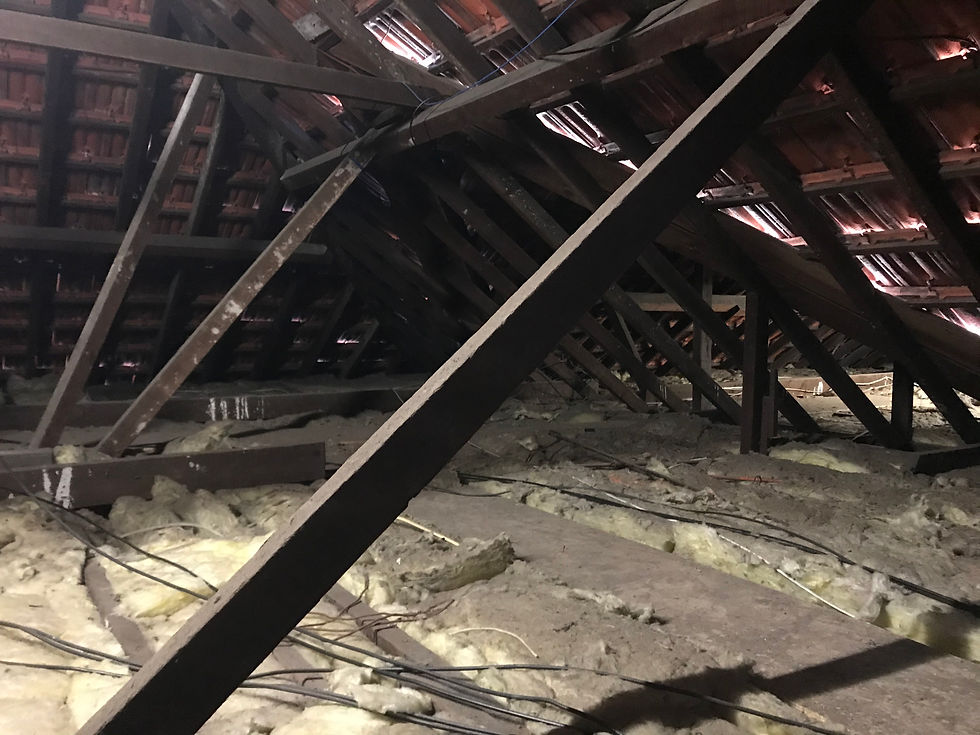
The roof area was vacuumed and insulated using a NSW Government grant.

Lime mortar reacts with pollutants and breaks down leaving sizeable gaps. An acrylic render was used to seal the brickwork and lime mortar.

Roof access is via a drop down ladder and ceiling trap door.
The roof area was vacuumed and insulated using a NSW Government grant.
Roof access, insulation and gable wall repairs, 2009
In 2009 access to the roof void was created via a new door and a NSW home insulation grant was used to insulate the roof void. The roof space was full of old tanks and cabling, and 80 years of black soot. Some of this was removed and 100mm of insulation installed together with some walkways and lighting. The lime mortar in the gable walls was badly eroded and so each gable was acrylic rendered on the inside.
The roof is still unlined (i.e. there is no sarking under the roof tiles) and so the black soot continues to accumulate and will do so until the roof tiles are replaced with sarking. However, the original terracotta roof tiles are in good condition and until these start to fail it is not an economic upgrade.
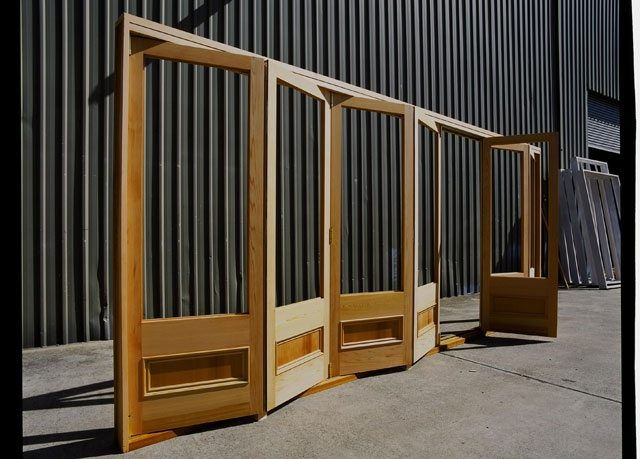
The installation of the kitchen bi-fold doors and removal of walls was put on hold in 2009.
The installation of the kitchen bi-fold doors and removal of walls was put on hold in 2009.
Lot 1 renovations (on hold from 2009)
These works are described in a second Special By-Law and commenced in 2008. The en-suite bathroom in the bedroom extension was abandoned and a Section 96 was approved by Woollahra Council for a new bathroom (to replace bedroom 2). However, in 2009 Lot 1 put these works on hold until the following had been completed:
1. Hot water system upgrade (completed 2013)
2. Extending the southern sewer line upgrade to the boundary trap (completed 2015)
3. Structural underpinning of the brick columns either side of the kitchen wall openings (completed 2015).
In 2019 the new bathroom to Lot 1 was completed as part of DA 322/2004/3 and a building certificate was issued by Woollahra Council.
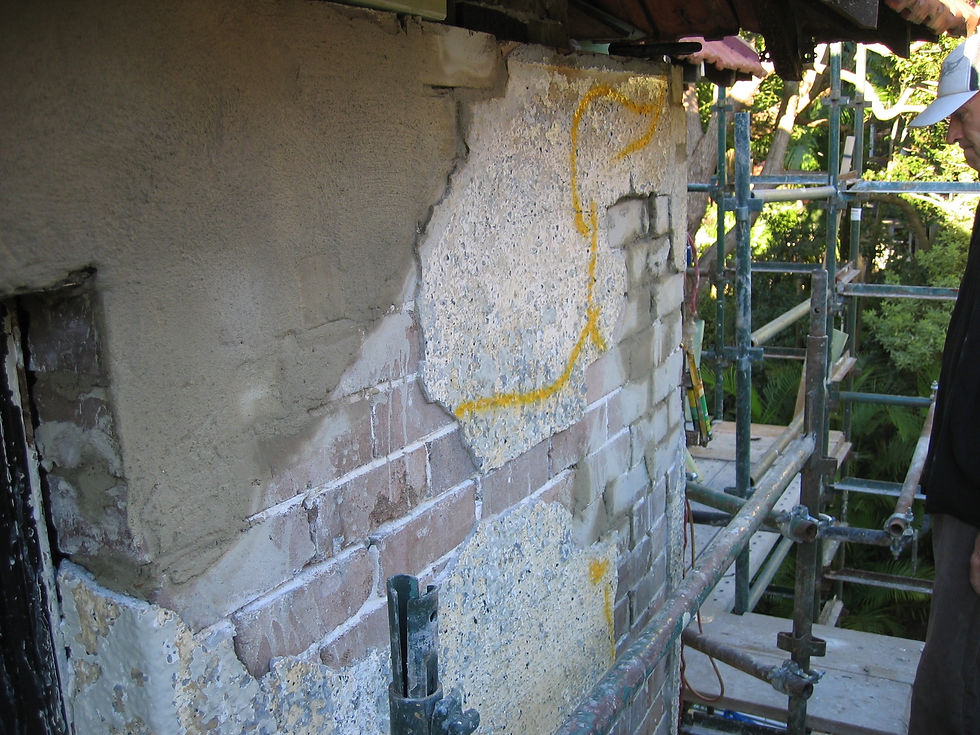
Removing the roughcast render to repair the cracking.

Across all facades, about 45 of the 70 lintels had failed and were replaced.
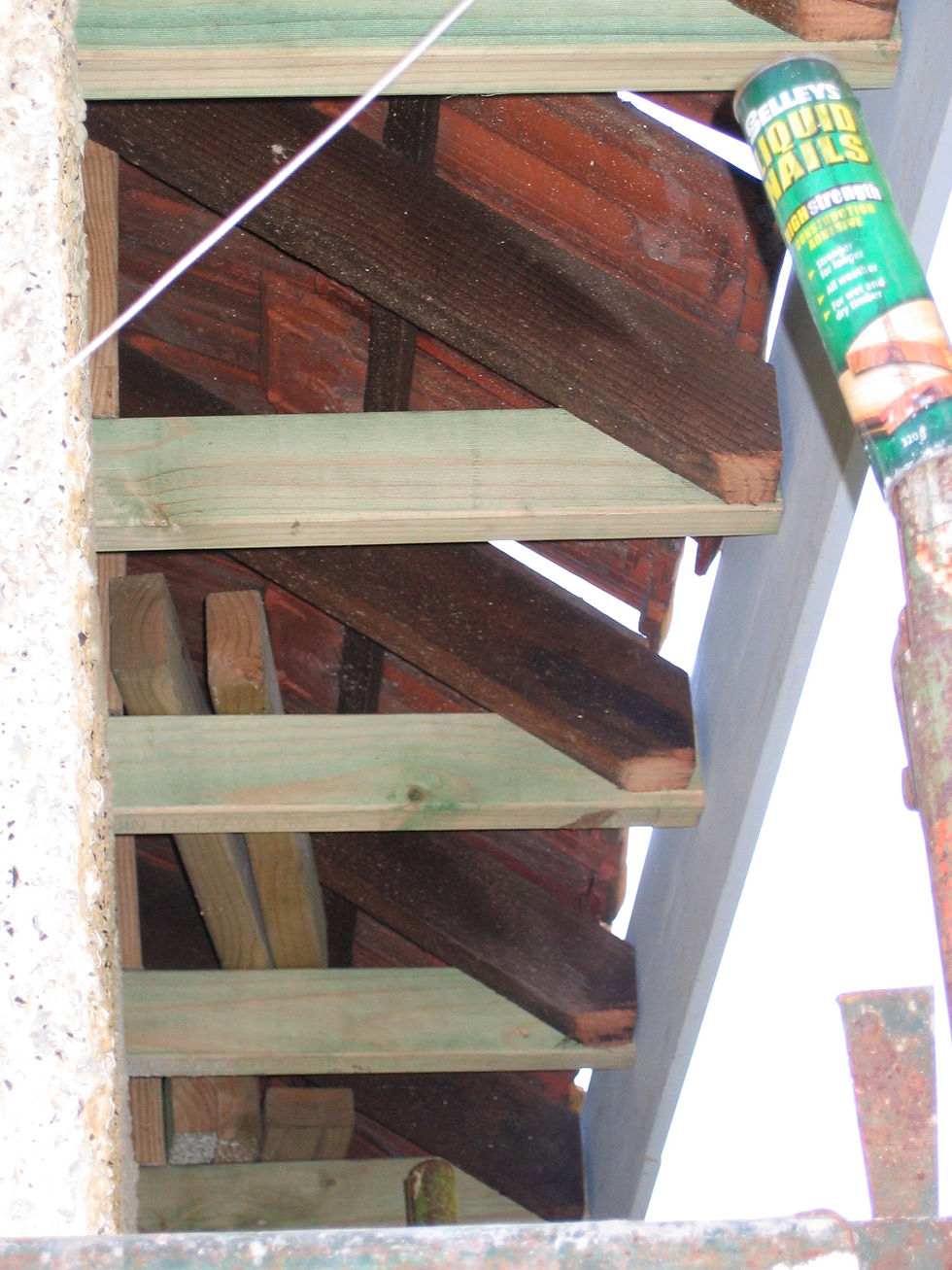
The eaves were rebuilt, and the gutters and downpipes replaced.
Removing the roughcast render to repair the cracking.
Northern facade repairs, 2009
As recommended in the Chapman Hutchison Report, and consistent with the works to other facades, in 2009 the northern facade was covered in scaffold and the external structural repairs undertaken. Building movement on the northern side of the building is at greater risk than the southern side due to the underlying groundwater conditions. Sometime before 1994, the building dropped about 70mm on the northern side and this meant that the scope of structural repair was far greater.
The work was undertaken by BSR Construction.
The structural repairs to the inner leaf of the external wall were completed in 2023.
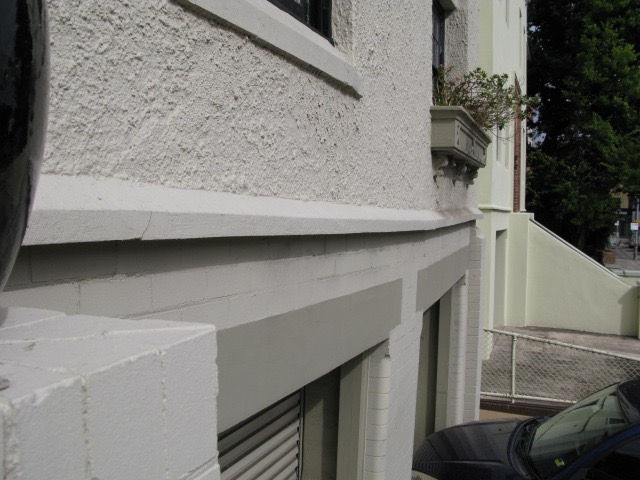
A major cause of the cracking was the 50 to 70mm of footing movement caused sometime before 1994.

Typical void created from the loss of lime mortar due to water ingress.

The internal cavity leaf of the brick wall is only accessible from inside units.
A major cause of the cracking was the 50 to 70mm of footing movement caused sometime before 1994.
Eastern (front) facade repairs, 2010
Consistent with the Chapman Hutchison Report, in 2010 the external structural repairs were undertaken to the eastern (front) facade. The amount of building settlement on the right hand side was extreme, and much of the cracking required brickwork to be rebuilt. Failed clinker ash lintels to roof corbels and brick arches made this facade very challenging for repairs.
The work was undertaken by BSR Construction.
In 2021, Sydney Water filled a major void under a concrete slab in Manning Road and this has greatly reduced the vibration from large passing trucks on bin day etc. The structural repairs to the inner leaf of the external wall were completed in 2023.
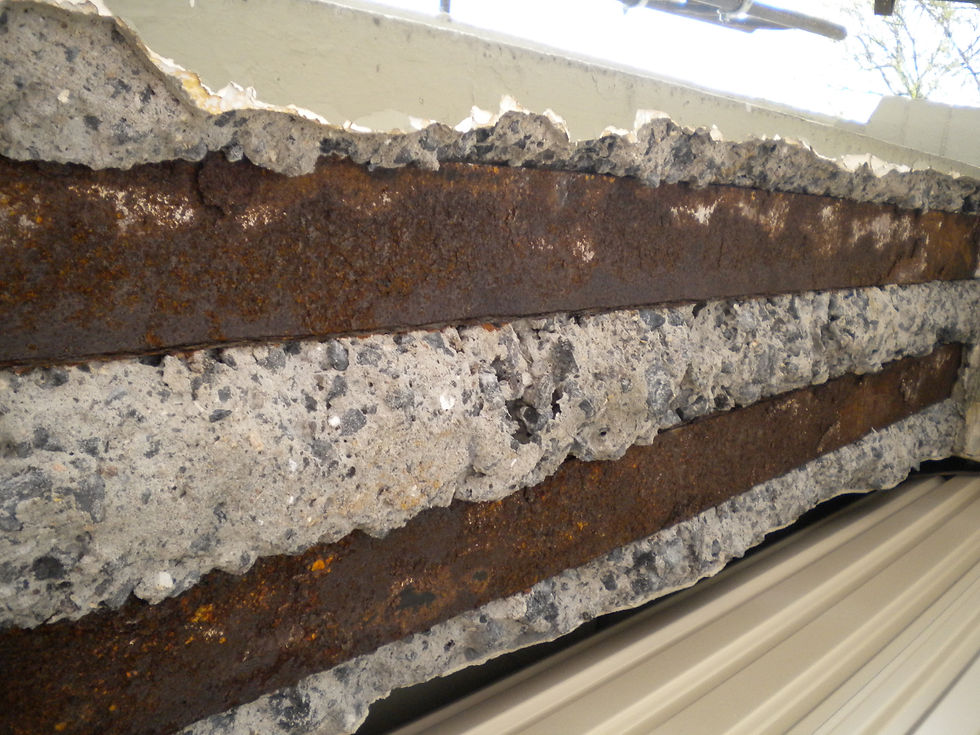
Garage beams to be replaced due to the risk of failure.
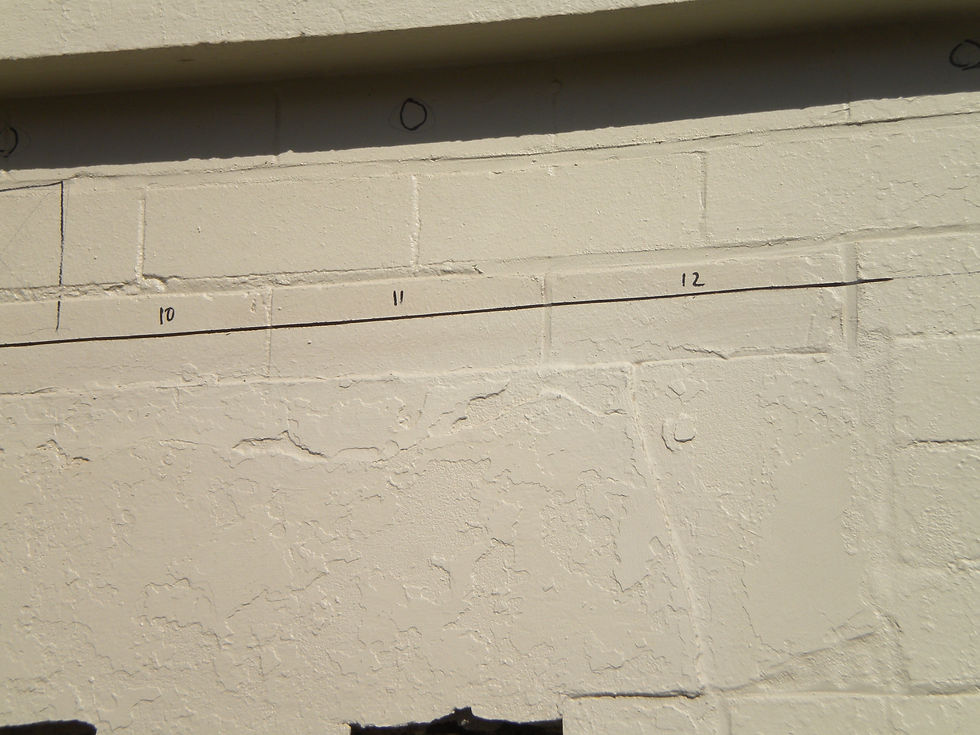
The line of the new beams to counter the building settlement.
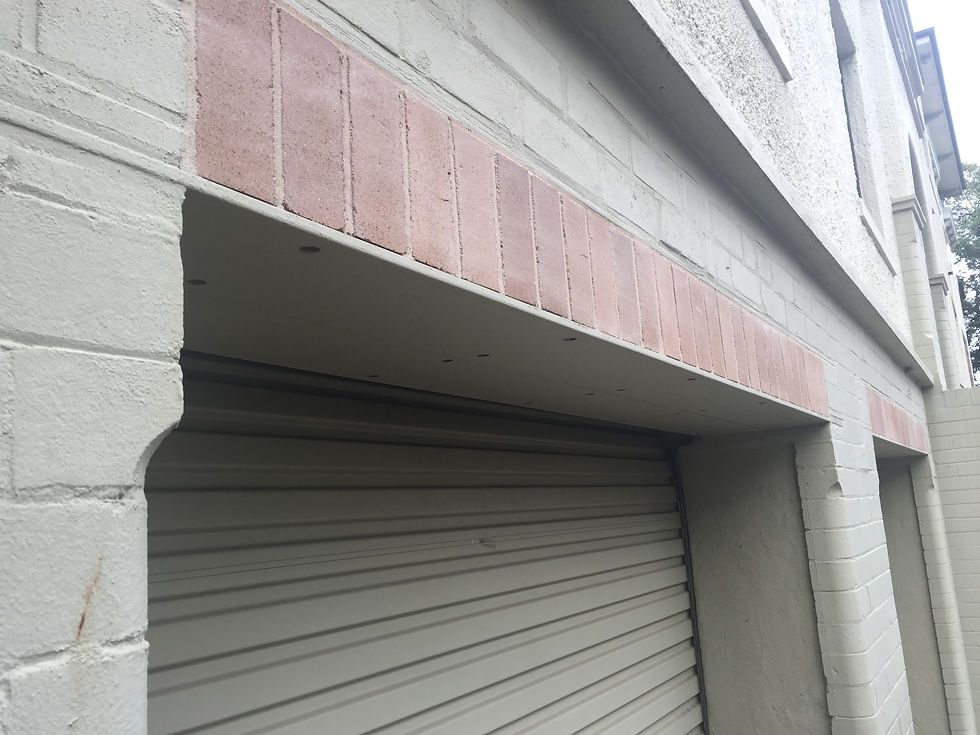
New galvanised steel beams with brick facing.
Garage beams to be replaced due to the risk of failure.
Garage beam replacement & electric doors, 2011
The garage door openings were deemed unsafe due to concrete cancer in the original beams.
A total of 8 galvanised steel beams were needed to rebuild the 4 door openings to Lots 2, 3, 5 and 6. This involved opening the asbestos ceilings in each garage to provide access for temporary wall props. The asbestos ceiling to Lot 5 was completely removed, but the painted asbestos ceilings to Lots 2, 3 and 6 still remain.
The work was specified by R Balas Consulting and undertaken by BSR Construction. The electrification of the garage doors was undertaken by J&K Roller Doors.
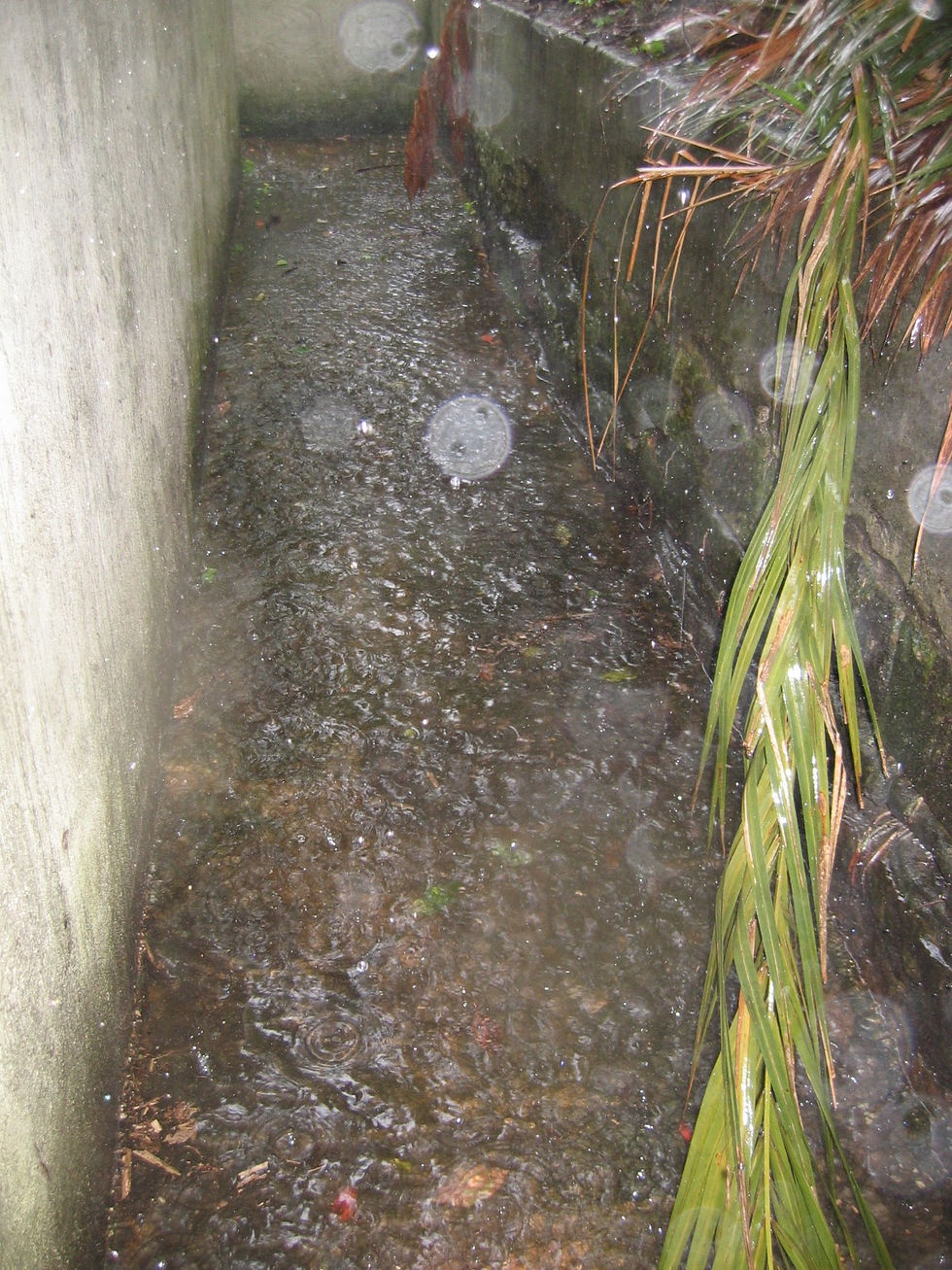
Poor drainage caused flooding of the path.
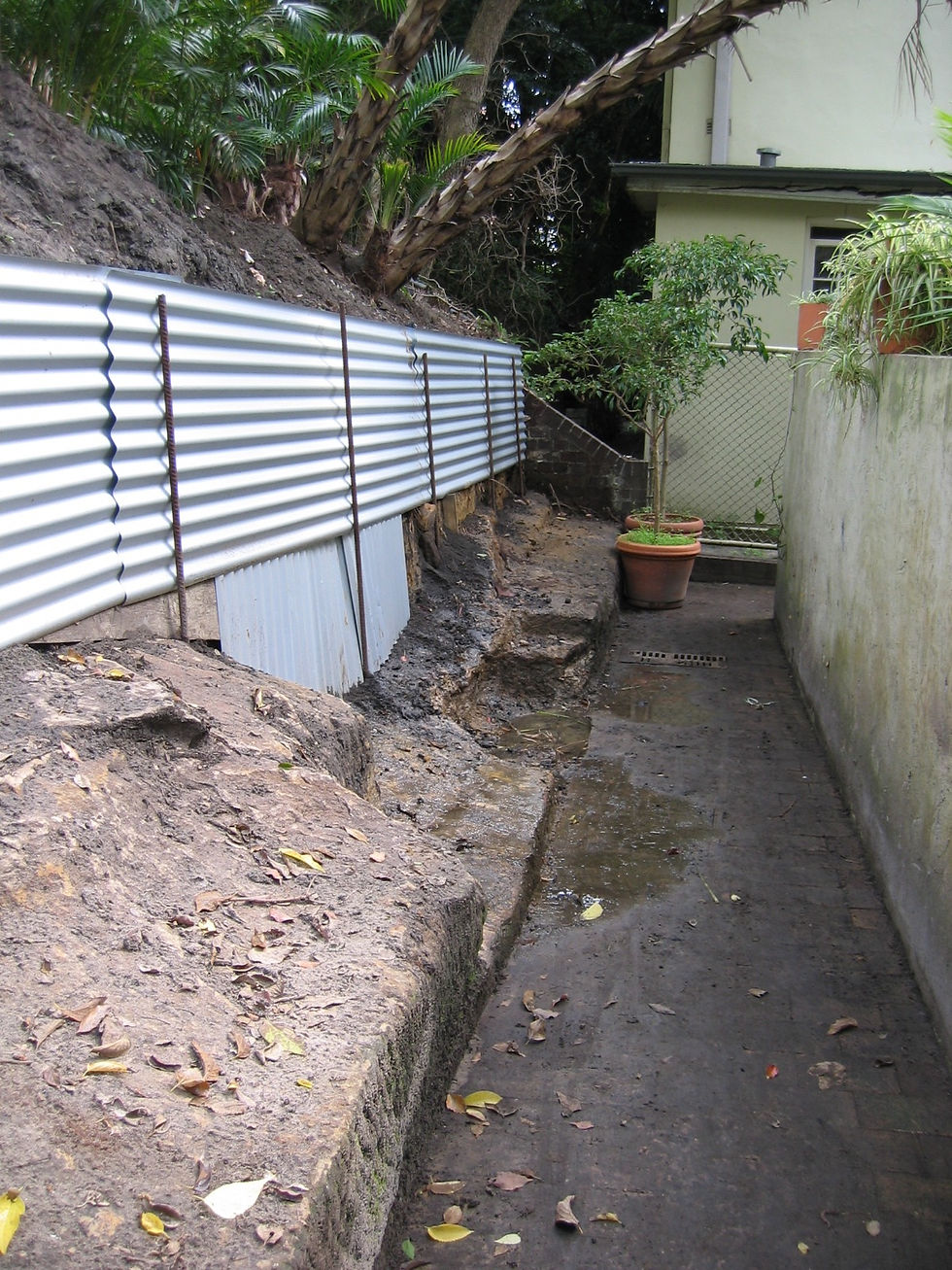
The concrete retaining wall had failed and a temporary wall was built in 2004.

A permanent retaining wall was built and the temporary wall removed.
Poor drainage caused flooding of the path.
Western retaining wall & drainage repairs, 2012
The failed retaining wall behind Lot 2 was identified by Chapman Hutchison in 2002, and removed in 2004. The offending tree was not removed until 2017. The area suffered from poor drainage and frequently flooded. Termites were discovered in Lot 2 in 2004 and the level of ground water infiltration was a key factor in attracting the ants to the area.
In 2012, a galvanised steel and timber retaining wall was built into the rock, and a new drainage sump with pump were installed.
The work was undertaken by BSR Construction and Hunter Metal Work. In 2023, the pump was removed and the drainage sump was connected to the stormwater system.

Each unit now has its own 6-star rated Rinnai 26 boiler with tempering valve.
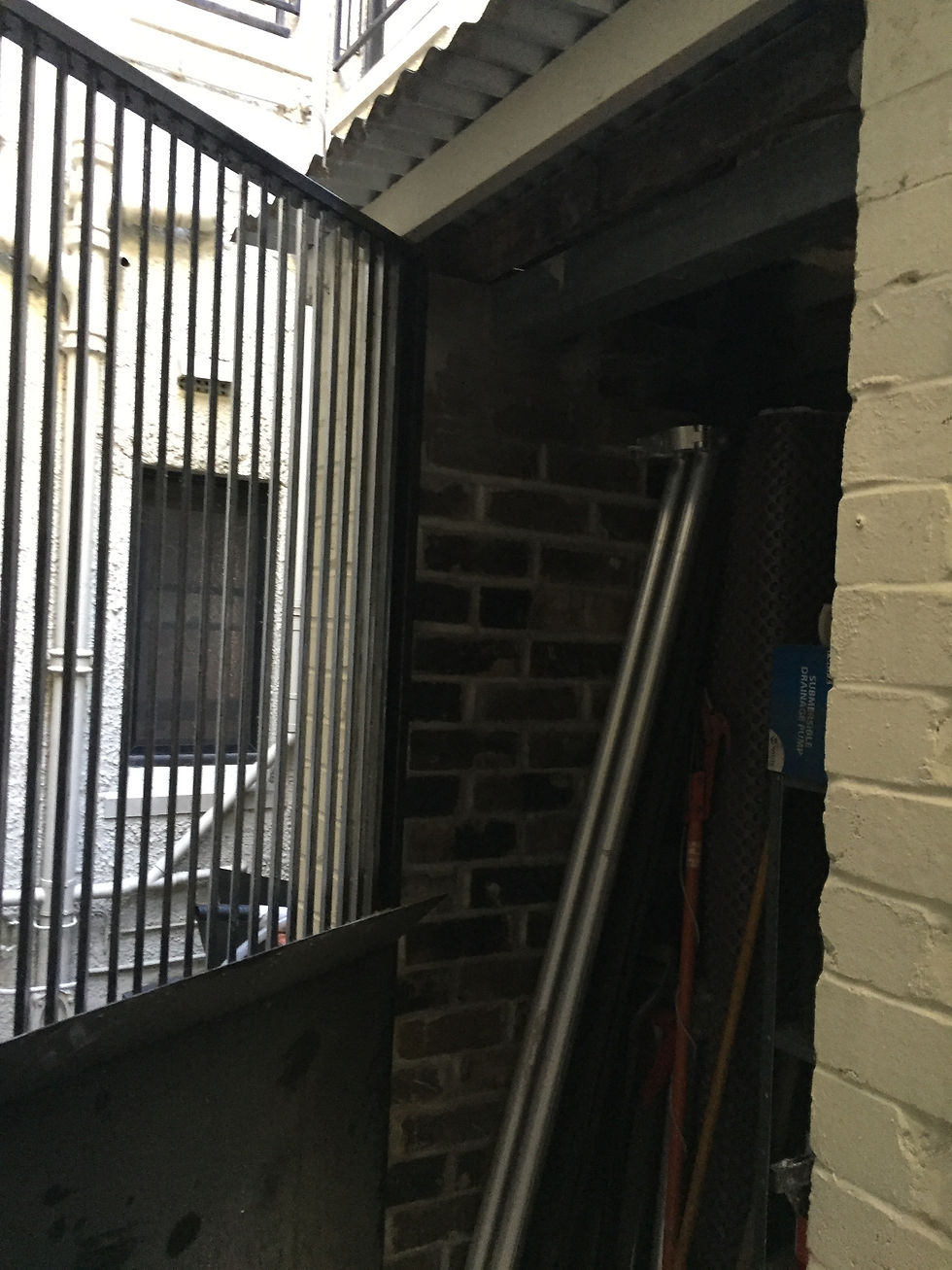
Centralised boiler system was decommissioned and removed.
Each unit now has its own 6-star rated Rinnai 26 boiler with tempering valve.
Hot water system upgrade, 2013
The original hot water system relied on a central boiler and a small bore return network to increase hot water response time. It had the ability to service about 18 persons in the building in peak times, and this was frequently stretched.
To upgrade the ageing system, each unit was provided with its own externally mounted gas boiler, together with a metered gas and water supply. All pipework was hidden inside 2 dedicated shafts inside the wall cavities. Individual unit boilers are Lot property in the Common Property Memorandum.
The work was undertaken by BSR Construction and Rubber Duck Plumbing.
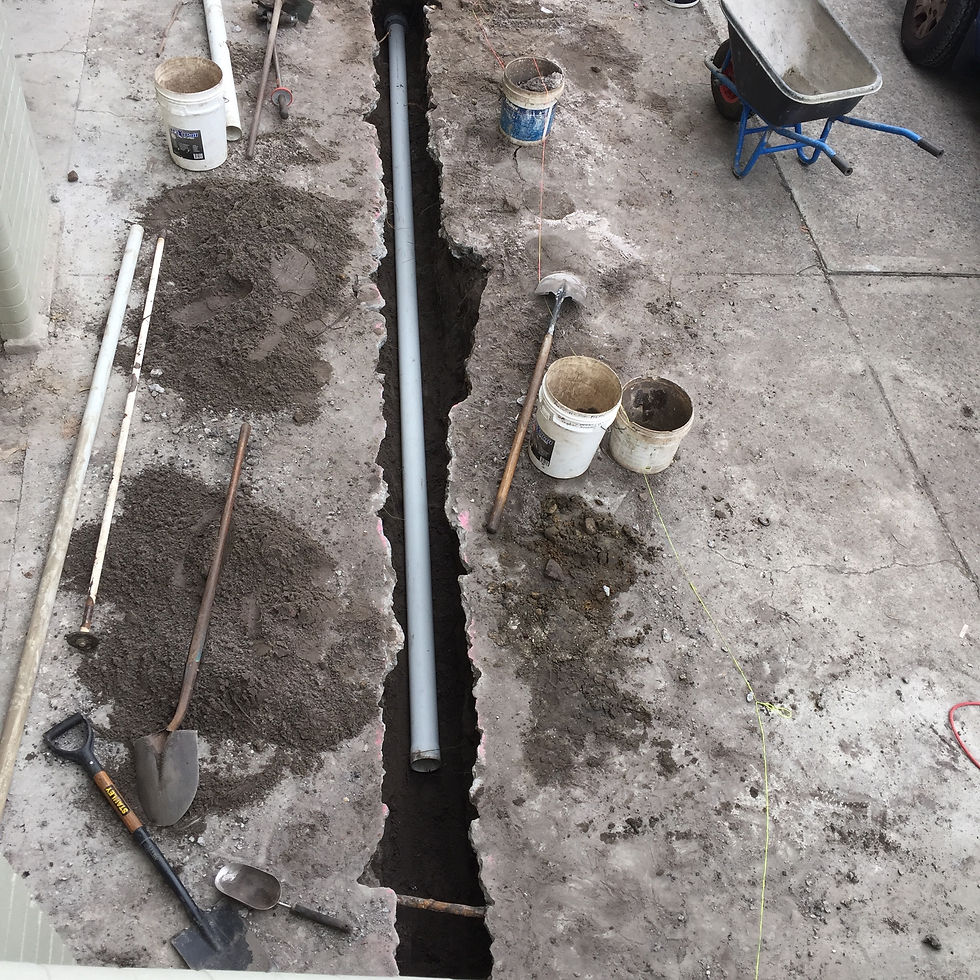
The replacement sewer line starts about 200mm from the boundary trap.

The section under the steps was lined with epoxy and then connected to PVC.
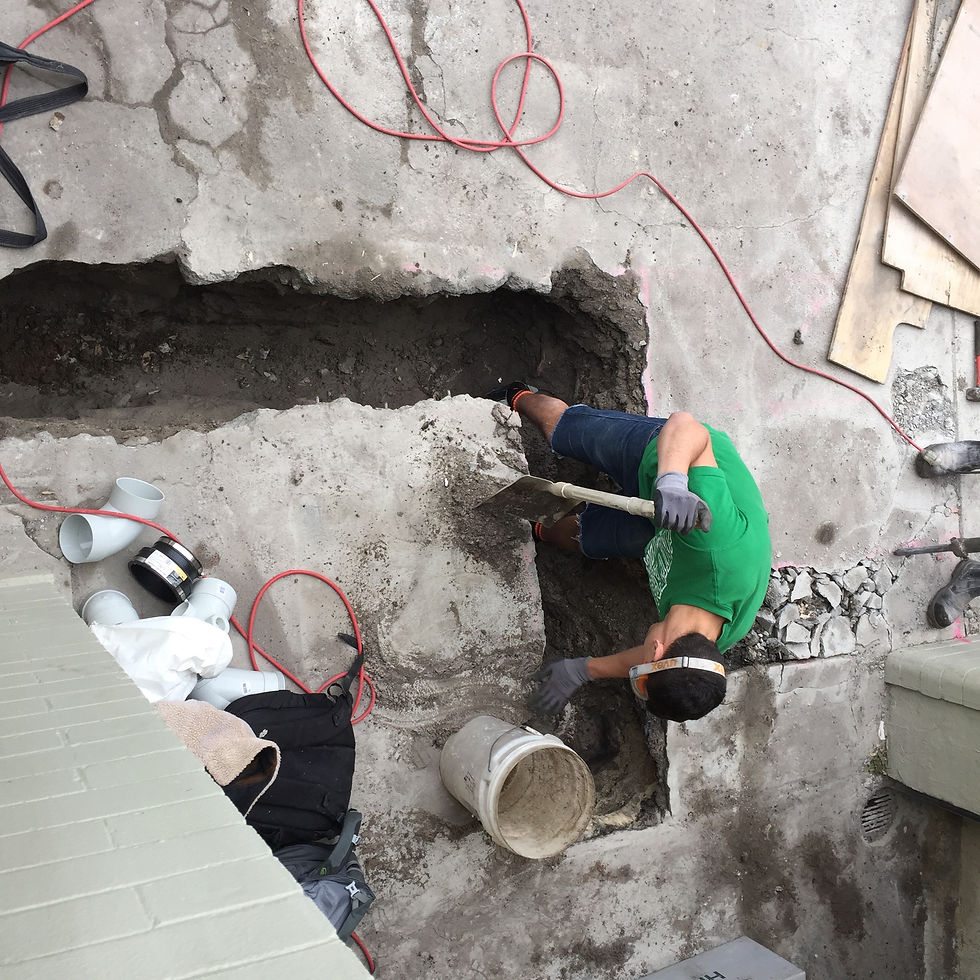
The replacement sewer line was connected to the southern sewer line via garage 5.
The replacement sewer line starts about 200mm from the boundary trap.
Eastern (front) sewerage upgrade, 2015
The proposed landscaping to the front facade meant that the sewer line needed upgrading to avoid tree root invasion. It had also been identified by Chapman Hutchison in 2002 that the sewer lines needed investigating. Both these goals were achieved, in part, with this project. The 4 metre section of clay pipe under the entrance steps had to remain, but was lined by Pipe Relining Solutions using an epoxy sock and is covered with a 20 year warranty.
The work was undertaken by Rubber Duck Plumbing with funding from Lots 1 & 5. The northern sewer line is still to be upgraded if any toilets are added to those Lots.
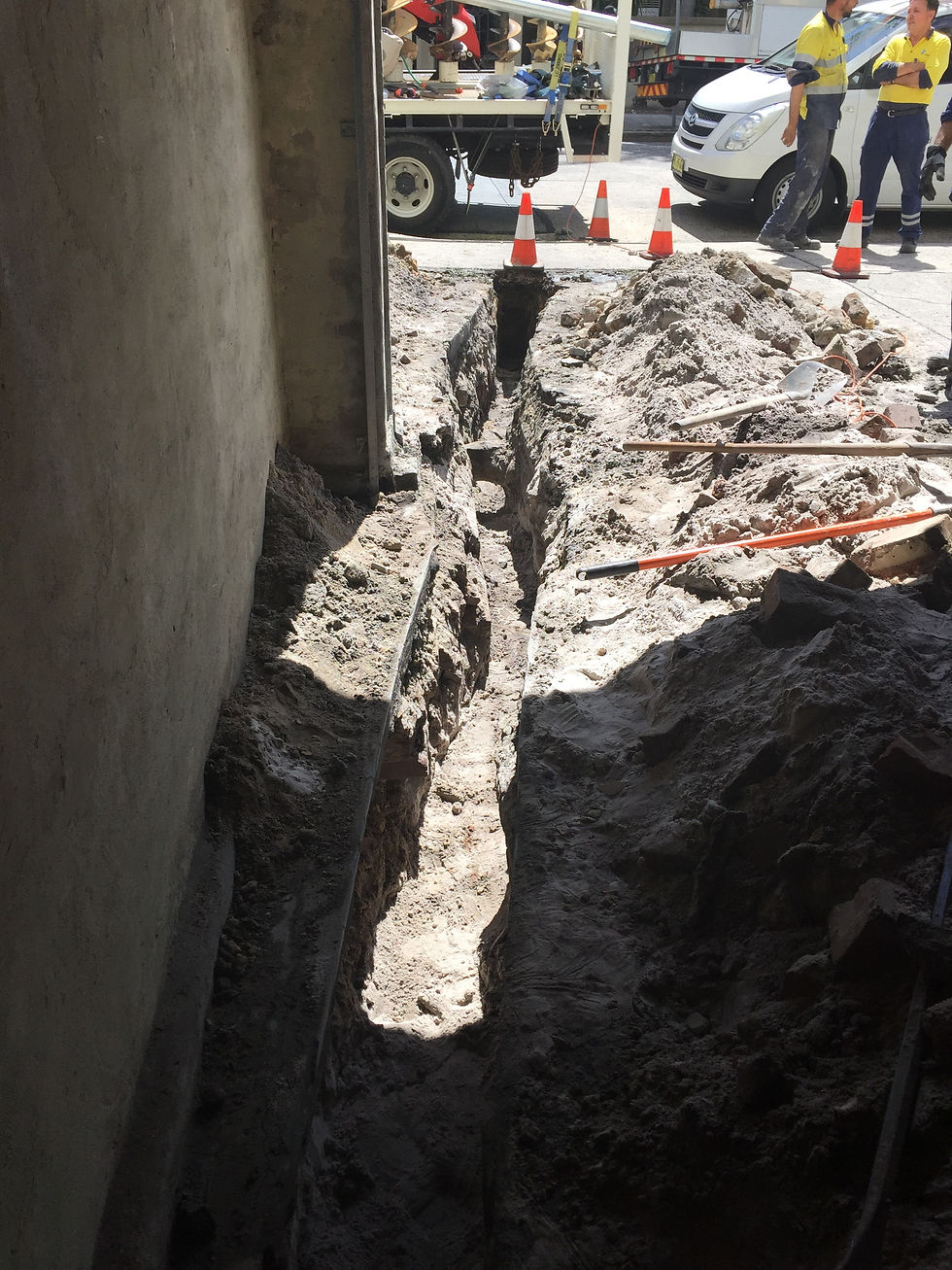
New 25mm cable runs under the courtyard and garage of Lot 5.
New 25mm cable runs under the courtyard and garage of Lot 5.
Electricity feed upgrade, 2015
A Level 2 electricity service provider upgraded the original 1928 supply cable to the building using a new 25mm 4 core XLPE service cable.
All meter panels were rewired to a new mains switch using 10mm PVC. Each unit is now limited to 50A and safety switches are fitted to all circuits. The only remaining 1928 cabling is in the lighting circuits of units 1, 2, 3 and 4, and the common stair area, but the use of safety switches minimises the risks from old cabling.
The Level 2 work was undertaken by Eris Electrical. The relocation of circuit breakers for each unit into Lot property, and the extension of the 10mm PVC cable into each Lot, has still to occur.
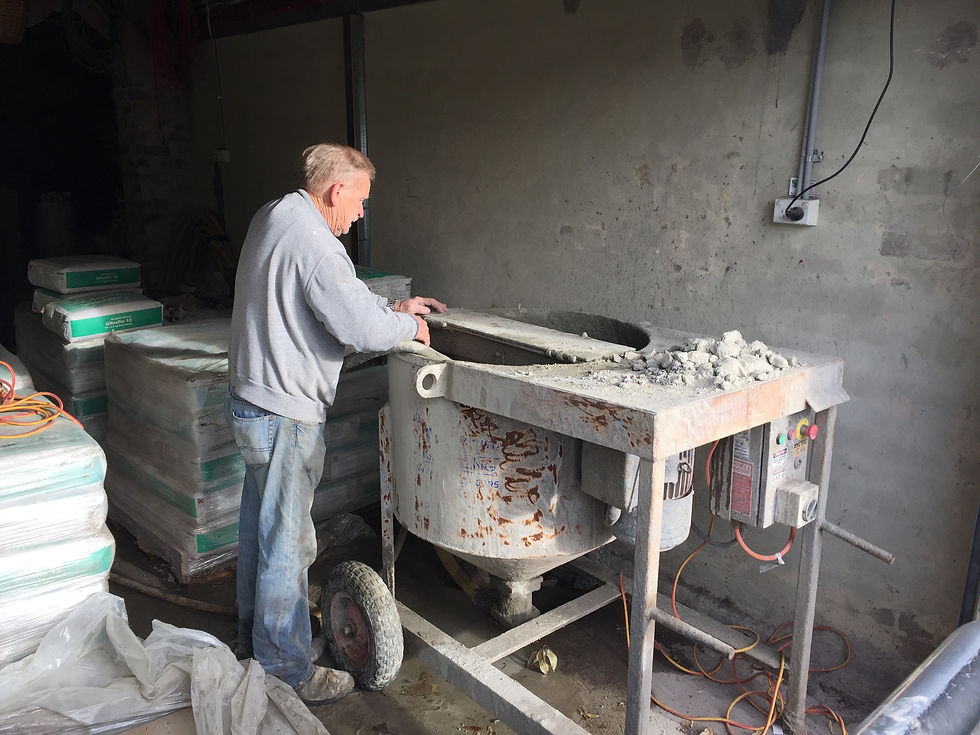
The mixing was done in a garage and pumped to the injectors.

Injection hole on southern elevation, in this case under the timber decking of Lot 1.

Injection holes in Lot 3 courtyard.
The mixing was done in a garage and pumped to the injectors.
Cement injection to eastern (front) facade, 2015
A cement injection technique was instigated as part of a Special By-Law whereby a superfine cement mix was injected into the ground to a depth of 2 to 3m, and this delivers a tensile strength of 5 to 10 MPa.
The work was initiated to safely permit the structural underpinning to the southern side of the building, but was extended to the eastern (front) elevation to stabilise the ground against future movement caused by changing ground water conditions. The load-bearing capability of the ground is not changed.
The work was inspected by R Balas Consulting and undertaken by GFW Australia, with funding from Lots 1 & 5.
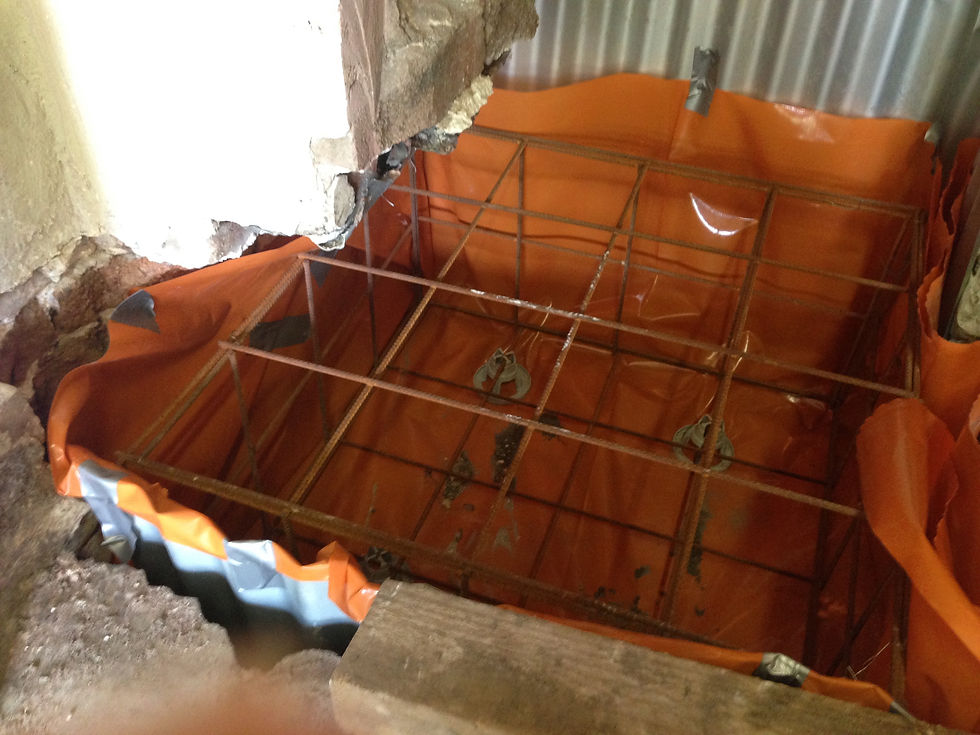
Six columns were underpinned to 2.1m below the original brick footing.

Early termination of underpinning to avoid any new load going onto the rock beneath.

900mm thick concrete pours and brick column underpinning, all to a depth of 2.1m below the original footing level.
Six columns were underpinned to 2.1m below the original brick footing.
Structural underpinning to southern side, 2015
Although underpinning was not considered cost effective by Chapman Hutchison, it does provide a permanent solution to footing movement if the rock and water conditions permit it. It also becomes a necessity if the load bearing structure is being altered near known footing movement, as in the case of the works described in Special By-Law 2.
To make the underpinning cost-effective, a 40cm deep sub-floor void was offered to all owners as a potential storeroom on the condition that whoever took up the offer underpinned the southern side of the building. Special by-Law 7 covers these works.
The work was specified and inspected by R Balas Consulting and undertaken by ADS Underpinning & Piering, with funding from Lots 1 & 5.
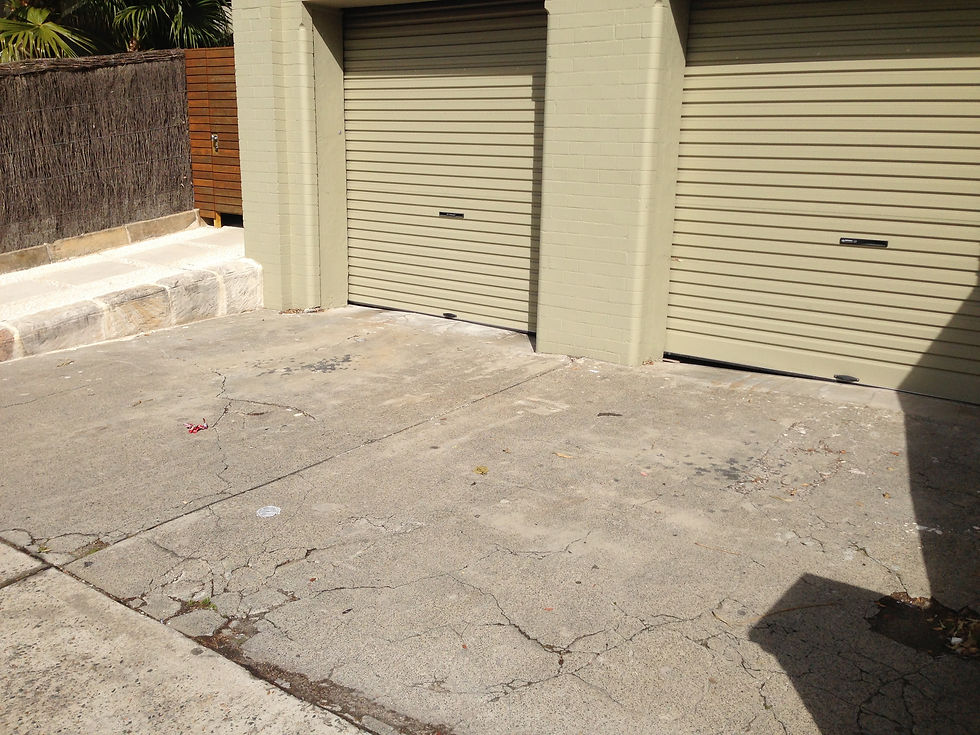
Suffered from extensive cracking and poor drainage.

Removing old material to the new level.

Magnolia trees, Japanese buxus hedges and cast iron urns.
Suffered from extensive cracking and poor drainage.
Driveway repairs & landscaping, 2016
The driveways were raised as a concern by Chapman Hutchison in 2002, and so after upgrading the eastern (front) sewer line and electricity feed the driveways to Lots 2, 3, 5 and 6 were excavated and road base added and compacted to new levels. The new concrete slabs were poured to a depth of 200mm using SL82 mesh and 32 MPa charcoal concrete.
Openings in the concrete were provided for planting 8 x Magnolia grandiflora "Kay Paris" and 160 x Buxus microphylla "Japonica". Provision was also made for Hunza lighting and Galcon irrigation.
The work was designed by Bay Street Gardens and R Balas Consulting, and undertaken by City Concrete, TM Services and Plantbiz.

Reliant on accessing the property of Lot 2
Reliant on accessing the property of Lot 2
Second bathrooms (stalled in 2018)
Second bathrooms (DA53/2016) rely on new drainage for sewerage and stormwater, as well as gas, electricity and cold water supplies passing through the courtyard of Lot 2 (property which can extend 3m below ground).
The depth of this new drainage is a function of the foundation design for Lot 2's extension (DA32/2017), which together with their own drainage design needs to be approved by Council before anything can be built.
All owners are reliant on Lot 2 to install the drainage needed for the second bathrooms without compromising their own development.
However, in 2018 the compulsory manager passed a Special By-Law for Lot 2 that excluded any drainage, and this effectively blocked the plan for second bathrooms.

An additional 26 collar ties were added to the roof structure.

Each new collar tie was bonded and bolted to the existing structure.
An additional 26 collar ties were added to the roof structure.
Roof truss sagging, 2022
In the Chapman Hutchison Update in 2018 it was identified that the timber to timber connections to the roof framing were moving as a result of the 1928 wrought iron nails rusting in the humid roof environment. The structural engineer specified "triple-grip" connectors and new galvanised nails. After further inspection, the proposed solution by the roofing truss carpenters was to add some additional timbers (called collar ties) and also use galvanised bolts instead of nails.
NCAT Orders dated 7 July 2022 (SC22/14942) ensured that twenty-six timber collar ties were added together with new props (the original roof was built with only 7 collar ties) and 70 galvanised bolts were added. Safe access platforms were also installed for NBN, FTA TV, roof vents, etc.
All works were completed by Chippys Carpentry.
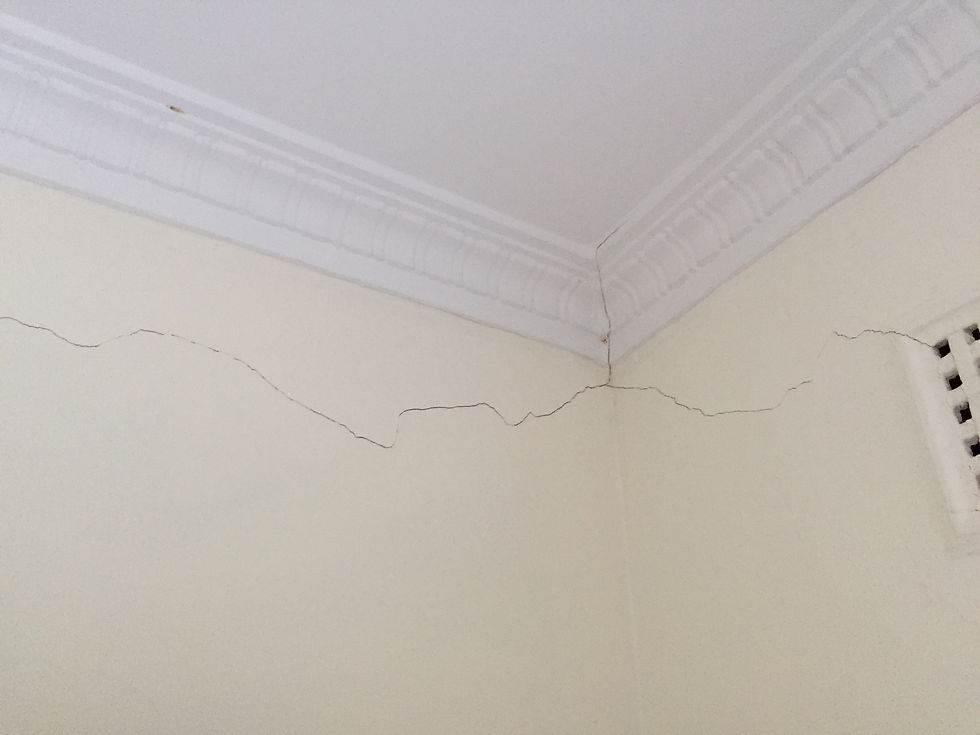
Typical cracking caused by movement in the roof structure above. Repaired in 2023.

Typical cracking caused by movement in the roof structure above. Repaired in 2023.

Typical internal cracking above window lintels replaced in 2007. Repaired in 2023.
Typical cracking caused by movement in the roof structure above. Repaired in 2023.
Internal structural repairs, 2023
The structural repairs needed to internal walls and the inner leaf of the cavity wall were as a result of roof movement and building settlement.
The roof movement caused cracking and displaced cornices in the upper part of the walls in the top two units – this repair work was executed as part of NCAT Order SC22/14942.
The cracking from building settlement was either as a result of the major drop under units 2, 4 and 6 sometime prior to 1994, or through changing ground water conditions which are more pronounced along the northern facade. An inspection of all internal plaster finishes adjacent to the internal lintels above windows and doors resulted in minor repairs as most of the major works had been completed in 2007 and 2010. All works were completed by Plasterfix.

Removal of the concrete steps to expose the broken pipes.

Repair of the 4" stormwater pipe to reconnect the system.
Removal of the concrete steps to expose the broken pipes.
Northern drainage repairs, 2023
The stormwater system along the northern facade had been temporarily repaired in 2010 with a large section relocated above ground. This temporary measure was undertaken as the two proposed developments in the area (DA32/2017 and DA53/2016) both required the replacement of the 4" system with a new 150mm pipe to the kerb in the street.
In 2023, both DA's had expired and so the existing 4" clay pipe system was repaired and reconnected. The sump pumps to the retaining wall behind Lot 2 were also removed and some sections of the original system were sleeved with an epoxy lining to manage tree root infiltration through the clay pipe connections.
All drainage repairs were completed by Howard Plumbing and the relining was completed by Sydney Relining.

Paint stripping back to bare wood

Checking the bottom corners of the sills for rot

Norglass Northane 2-pack paint finish
Paint stripping back to bare wood
Window repairs (2024)
The windows were raised as a concern by Chapman Hutchison in 2002 and repainted between 2007 and 2010 with new timber quadrants adjacent the brickwork.
In 2024/25, the building was again covered in scaffolding and the windows were stripped and repainted using the Norglass Northane 2-pack paint system. As part of the preparation, the sill corners were checked for rot, any cracked glass was replaced, the putty and sash cords were replaced where necessary, sikaflex 11FC was used to seal brickwork and timber joints, and the top sash was permanently secured. The damaged sills from the old window boxes adjacent units 2 and 4 were repaired using sikaflex 11FC. Some owners also took steps to temporarily upgrade their window safety devices using a compliant subframe system.
All works were completed by TAK Projects.

Using sikaflex 11FC at the joints of any dissimilar materials

316 stainless strap to one of the outward facing butresses
Using sikaflex 11FC at the joints of any dissimilar materials
Membrane repairs (2025)
To abate the influx of rainwater into the structure, the building membrane was renewed between 2005 and 2010 as part of the staged works to each facade. The Dulux specification relied on water blasting to remove the old calcimine base paint, X10 Weathershield as a primer, and AcraTex AcraShield as a top coat.
In 2024/25, the building was again covered in scaffolding and a new membrane was applied to all walls. The last remaining section of the old calcimine paint in the lightwell was removed beforehand. With the scaffolding in place all external lintels were inspected by engineers as well as the two outward facing roof corbels on the eastern elevation as they were not accessible in 2010. The membrane system was from Taubmans.
All works were completed by TAK Projects.

Membrane works nearing completion
Membrane works nearing completion
Engineer's inspection (2025)
Since 2002, two engineers have principally supported the progress of works at 13 Manning Road - Chapman Hutchison and R.Balas Consulting.
Chapman Hutchison provided reports in 2002, 2018, 2019 and various reports in 2022. The Directors of this firm have since retired. R.Balas Consulting has been used for most of the design and staged inspections of works since 2006, including the garage steel beams, concrete driveways, underpinning, retaining walls, drainage and any Council certification.
In 2025, R.Balas Consulting provided a letter of completion for the various reports issued by Chapman Hutchison in 2022 and undertook an inspection of the building whilst the scaffolding was in place to confirm the condition of the lintels, external membrane, roof and stormwater drainage.